
Understand Your Undertone
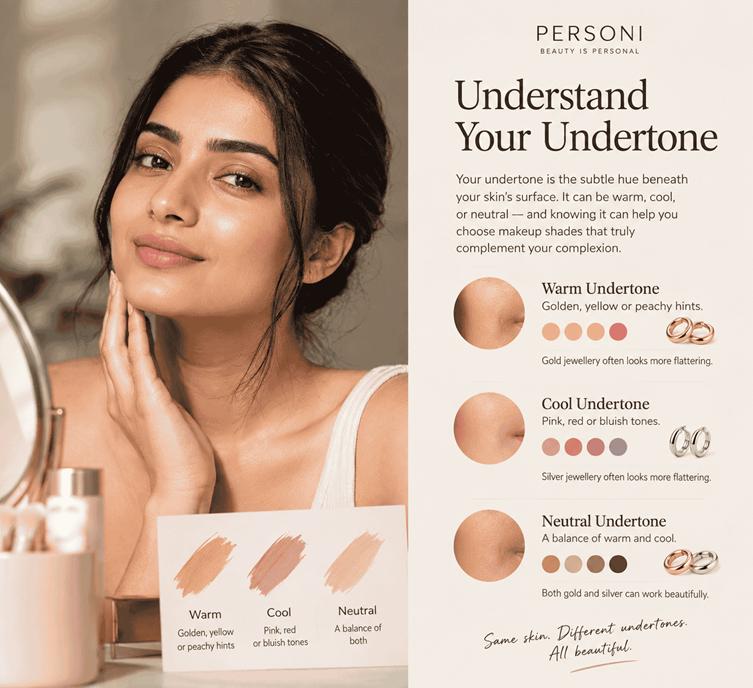
Finding your perfect makeup shade begins with understanding more than just your skin tone. Your undertone is the subtle hue beneath the surface of your skin, and it can influence how different makeup colours appear once applied. While skin tone can change with seasons, sun exposure, or tanning, your undertone generally remains consistent.
There are three common undertones: warm, cool, and neutral. Warm undertones often have golden, yellow, or peachy hints, while cool undertones can lean towards pink, red, or bluish tones. Neutral undertones sit comfortably between the two, combining elements of both.
For Personi, understanding your undertone is about more than finding the “right” foundation. It is about discovering colours that naturally complement your complexion. The right undertone match can help foundation blend more seamlessly, blush look more harmonious, and lip and eye colours feel naturally balanced.
Try checking your skin in natural daylight rather than relying solely on indoor lighting. Look at your overall complexion, experiment with different shades, and pay attention to which colours make your skin appear fresh and balanced.
There is no ideal undertone—only your undertone. And understanding it gives you another way to make beauty choices that feel personal, confident, and completely your own.
The Colour Story Beneath Your Skin
Every complexion carries its own colour story—and it goes deeper than what meets the eye. While your skin tone describes the visible depth of your complexion, your undertone is the subtle hue beneath the surface that quietly influences how colours appear on you.
It may be warm, with hints of golden, yellow, or peach; cool, with pink, red, or bluish notes; or neutral, where warm and cool tones naturally find balance. This underlying tone can make the same makeup shade look completely different from one person to another.
At Personi, we see this difference as something to celebrate. Beauty isn’t about finding one universally perfect shade; it is about discovering the colours that naturally work with your individual complexion. Understanding your undertone can make everything from foundation and blush to lipstick and eyeshadow feel more intuitive.
Think of your undertone as the quiet foundation of your colour palette. It can help explain why certain shades make your complexion look fresh and radiant, while others may appear slightly dull or disconnected.
Once you begin recognising your undertone, choosing makeup becomes less about following rules and more about understanding what complements you. Your skin already has its own colour story—Personi simply helps you explore it.
Every Complexion Has More Than One Story
Your complexion is more than a single shade. It is a combination of depth, undertone, texture, and natural variations that make your skin uniquely yours. Two people may have a similar skin tone, yet the same makeup shade can look entirely different on each of them. That difference is part of what makes beauty personal.
Your skin tone describes the visible depth of your complexion, while your undertone reveals the subtle colour beneath it. Together, they influence how makeup interacts with your skin and how different colours appear once applied.
At Personi, we believe this individuality deserves to be understood rather than covered up. Whether your undertone leans warm, cool, or neutral, there is no “correct” complexion to aim for. The goal is simply to find shades that complement your natural colouring and make you feel comfortable in your own skin.
Understanding your complexion can also make your beauty routine more intentional. Instead of choosing colours based only on trends or what looks good on someone else, you can explore shades that naturally harmonise with you.
From a foundation that blends seamlessly to a blush or lipstick that brings warmth and balance to your face, the right colour can enhance without overwhelming. Because every complexion has more than one story—and every story deserves to be celebrated.
Discover the Colour Beneath Your Complexion
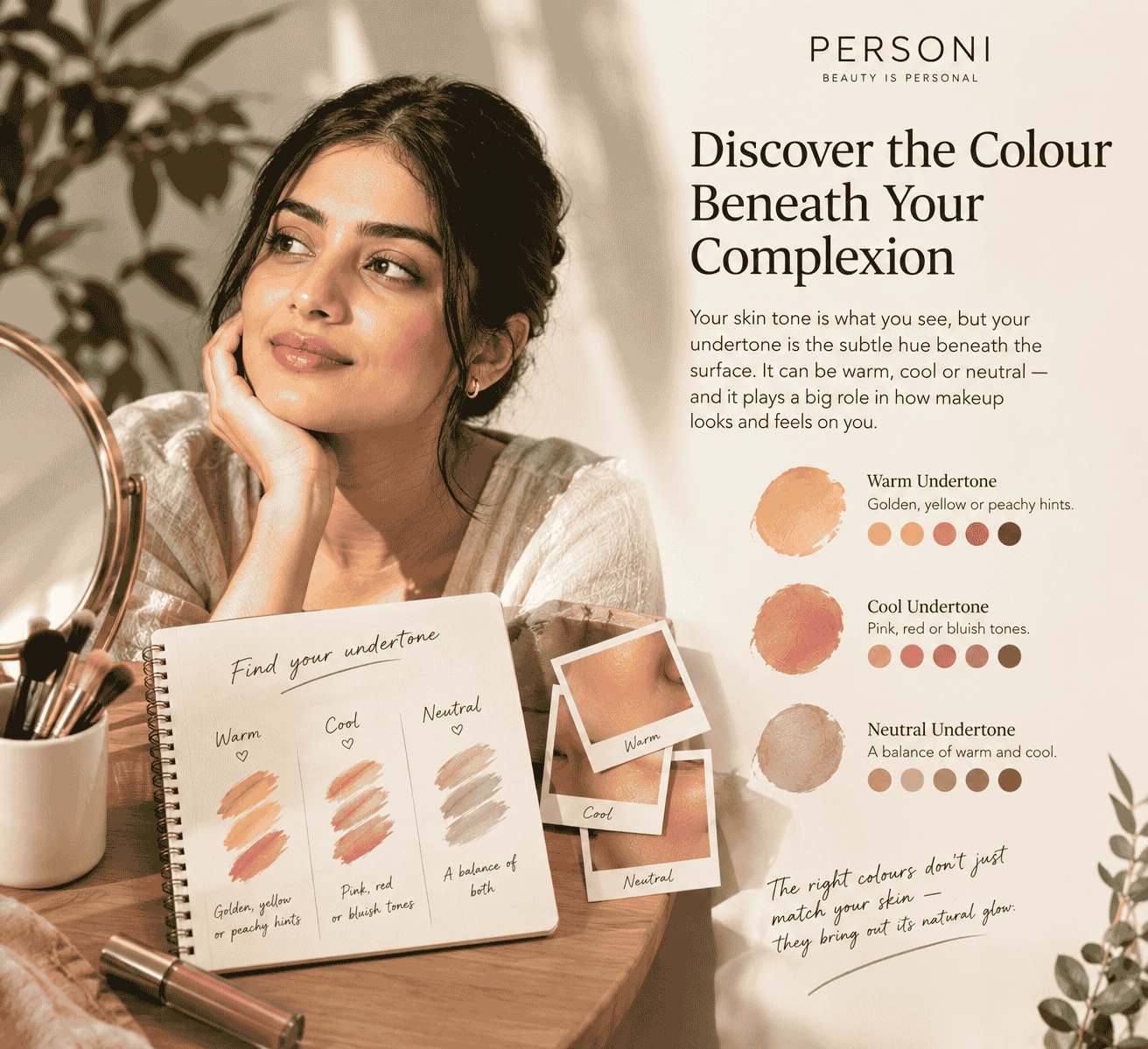
What you see on the surface is only part of what makes your complexion unique. Beneath your visible skin tone lies a subtle hue known as your undertone—a quiet influence that can shape the way makeup shades appear on you.
Your undertone generally falls into three categories: warm, cool, or neutral. Warm undertones often carry golden, yellow, or peachy hints, while cool undertones may have pink, red, or bluish qualities. Neutral undertones sit somewhere between the two, offering a natural balance of warm and cool characteristics.
At Personi, we believe discovering your undertone is not about following strict beauty rules. It is about understanding your complexion and making more informed choices. The right undertone can help foundation blend naturally into your skin, while complementary blush, lipstick, and eyeshadow shades can bring greater harmony to your overall look.
Natural daylight is one of the simplest ways to observe your complexion accurately. Take a moment to look at your skin without heavy makeup and notice the colours that naturally complement it. You can also experiment with different shades and see which ones make your complexion appear fresh, balanced, and naturally radiant.
Your skin already has its own colour story. Discovering your undertone simply helps you understand it better—and choose beauty that feels uniquely yours.
Your Perfect Makeup Match Starts Beneath the Surface
Finding makeup that truly feels right begins with understanding your skin beyond its visible shade. While your skin tone tells you how light, medium, or deep your complexion appears, your undertone reveals the subtle colour beneath it. This often-overlooked detail can make a meaningful difference when choosing makeup shades.
Undertones are generally grouped into three categories: warm, cool, and neutral. Warm undertones tend to have golden, yellow, or peachy hints, while cool undertones can lean towards pink, red, or bluish tones. Neutral undertones combine characteristics of both. Understanding where your complexion sits can make shade selection feel less confusing and more personal.
For Personi, makeup is not about changing who you are—it is about finding products that work naturally with your individuality. A well-matched foundation can create a seamless base, while the right blush, lipstick, or eyeshadow can complement your complexion and bring balance to your overall look.
The best place to begin is natural daylight. Observe your skin without heavy makeup, explore different shades, and notice which colours make your complexion look fresh and harmonious.
Ultimately, the perfect makeup match isn’t about following someone else’s formula. It starts with understanding your own skin—and choosing beauty that works with it, not against it.
Conclusion
Your skin tells a story that goes beyond its visible tone. Understanding your undertone helps you see the subtle colours that influence how makeup interacts with your complexion, making shade selection more personal and intuitive. Whether warm, cool, or neutral, every undertone has its own character—and every one deserves to be celebrated.
At Personi, we believe makeup should complement your individuality rather than cover it. Knowing your undertone can help you choose foundation, blush, lipstick, and other shades with greater confidence, but beauty is never about following a fixed set of rules. It is about discovering what works beautifully for you.
Once you understand the colour beneath your complexion, you can begin creating a makeup palette that feels naturally harmonious. The right shade isn’t simply the one that matches—it is the one that makes you feel like yourself.
Because your beauty is personal, your colours are personal, and your makeup should be too. With Personi, discover what complements you and make every shade your own. Personi