
Understanding Undertone: Warm, Cool, and Neutral
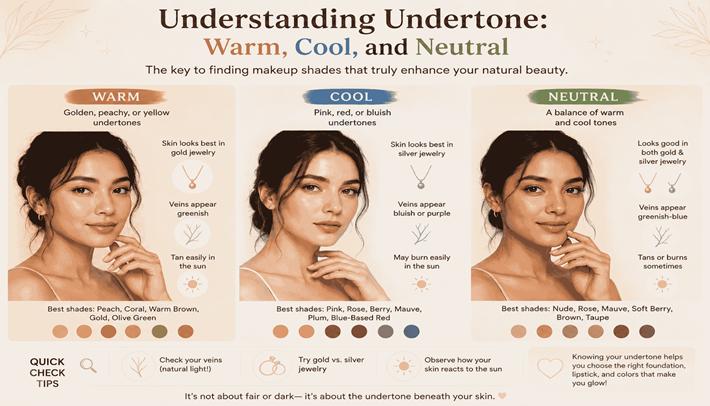
At Personi, we believe great makeup starts with understanding your skin — and undertone is where that understanding truly begins. It’s the subtle hue beneath your skin that stays constant, even as your tan changes with the seasons. Foundation
If your skin leans golden or peachy, tans easily, and gold jewellery suits you better, you likely have a warm undertone. Personi’s BB Matte Teint Foundation and peach-based blush shades are designed to blend seamlessly into warm skin, giving you that natural, no-makeup finish without any grey or ashy cast.
If you burn before you tan, silver jewellery flatters you more, and your skin has a pink or rosy base, you’re likely cool-toned. Our rosy blush palettes and berry-toned lip crayons are built to complement cool undertones beautifully, adding colour that looks like it belongs.
Neutral undertones sit comfortably between the two — a balanced mix that adapts well to most shade families, including Personi’s versatile foundation range.
Knowing your undertone helps you choose the right Personi shade the first time, instead of relying on guesswork. Because the right formula isn’t about what’s trending — it’s about what actually matches you. That’s the difference real shade-matching makes.
How to Find Your Actual Shade Match at Home
Finding your real shade match doesn’t need a store visit or a stranger’s guess — just better lighting and a little patience. Start by testing foundation on your jawline, not your hand or wrist, since the skin tone there rarely matches your face. Apply three shades that look close in your undertone family and blend them in without wiping off — the one that “disappears” into your skin is your match.
Natural daylight is non-negotiable. Test near a window, away from yellow-toned indoor bulbs that distort every shade. Let the foundation sit for 10-15 minutes before deciding, since most formulas oxidize slightly and shift a shade darker or warmer once they meet your skin’s natural oils.
If you’re unsure of your undertone, check the veins on your wrist: green suggests warm undertones, blue suggests cool, and a mix usually means neutral. Match your foundation family accordingly, then fine-tune with the jawline test.
Skip photos under flash — they lie. Trust daylight, trust your jawline, and give the formula time to settle before you decide it’s “the one.”
The Case for Testing Across Diverse Skin Tones
A foundation that looks flawless on five models with similar skin tones tells you almost nothing about how it performs in the real world. True testing means putting a formula against the full spectrum of human skin — deep, medium, fair, olive, warm, cool, and everything in between — before it ever reaches a shelf.
This matters because skin doesn’t just vary in depth; it varies in undertone, texture, and oil production, all of which affect how a formula oxidizes, blends, and wears through the day. “Without this diversity, shade ranges often cluster in the middle, leaving extreme skin tones with only ‘close enough’ options.”
“Diverse testing reveals issues homogenous testing misses: ashiness, orange-casting, or formulas failing on oilier skin textures. It’s not just about representation — it’s about function.
Brands that skip this step aren’t just being exclusionary; they’re releasing an untested product for a large share of their potential customers. Real inclusivity in beauty isn’t a marketing checkbox — it’s a testing standard. And it starts long before the shade range ever reaches the customer.
Signs Your Foundation Isn’t as Universal as It Claims
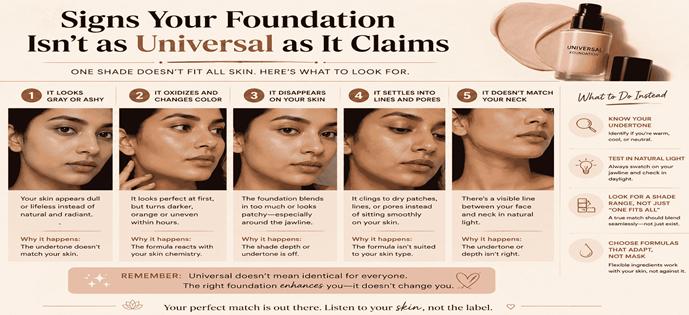
“Universal shade” is one of the most overused promises in beauty — but your skin will tell you the truth long before the packaging does. The first sign is oxidation: if your foundation turns noticeably darker or more orange an hour after application, it’s adjusting to your skin chemistry, not matching it from the start.
Watch for patchiness around drier areas like your nose or forehead — a truly adaptive formula should sit evenly, not cling to texture or settle into fine lines. If you constantly need a different concealer shade to “fix” your foundation, that’s another red flag; a good match shouldn’t need correcting within minutes of application.
Pay attention to how it looks in different lighting. A shade that reads fine indoors but suddenly looks ashy or too warm in daylight isn’t blending — it’s compromising. Similarly, if your neck and jawline show a visible line of demarcation, the “universal” claim is already falling apart.
Lastly, notice how it wears by midday. A shade that fits your skin should fade evenly, not turn patchy or shift undertone entirely. If any of these signs feel familiar, your foundation isn’t adapting to you — you’re adapting to it. That’s worth questioning.
What to Look for Beyond the Bottle’s Promise
Packaging claims are designed to sell — not to guarantee a match. “Long-lasting,” “universal shade,” or “24-hour wear” sound reassuring, but the real proof is in how a formula behaves on your specific skin, not what’s printed on the label.
Start by checking the ingredient list rather than the marketing copy. Look for whether the formula addresses your actual skin concern — oil control, hydration, or buildable coverage — instead of vague promises of “flawless finish.” A long list of impressive-sounding claims often hides a formula that’s average at everything and excellent at nothing.
Test wear time yourself instead of trusting the label. Apply it during a normal day — not a controlled five-minute demo — and see how it holds up through heat, sweat, or a meal. Notice whether it fades evenly or breaks down into patches, since that says more about compatibility than any bottle ever could.
Also consider how the shade performs across different lighting, not just under the store’s flattering setup. And don’t ignore how your skin feels hours later — tightness or breakouts speak louder than any “gentle formula” claim.
The bottle sells a promise. Your skin, over a full day, is the one that actually delivers the verdict.
Conclusion
At the end of the day, no bottle, ad, or shade chart can replace what your own skin tells you. “One shade fits all,” “universal match,” and “24-hour wear” are marketing lines built to sell confidence — not guarantees built on your actual undertone, texture, or lifestyle. Real shade-matching isn’t about trusting a label; it’s about testing on your jawline, in daylight, and over a full day to see how a formula truly behaves once it meets your skin.
This is exactly why understanding your undertone, testing across diverse skin tones, and knowing the warning signs of a mismatch matter so much. They shift the power back to you, the customer, instead of leaving you dependent on a brand’s promise.
At Personi, we believe good beauty isn’t about convincing you a formula works — it’s about building shades and formulas that actually do, across real skin, real tones, and real days. Because the goal was never to fit everyone into one shade. It was always to help you find the one that was made to fit you.
That’s not just better marketing. That’s better beauty.